For a cabinet refacing project, SEKTION is the stronger starting point of the two IKEA lines, but when durability, style range, or precise fit truly matter, custom doors from Tdm-thedoormaker are the smarter long-term choice.
SEKTION uses melamine construction with a broader selection of face styles, making it more compatible with quality replacement doors. ENHET’s lower-cost fiberboard and paper-filled panels limit how well new hardware and custom doors will hold over time. Either way, the cabinet boxes stay put during refacing — what changes are the doors, drawer fronts, and visible surfaces.
- ENHET: Best for budget-conscious projects where the boxes are in good shape and you want a quick cosmetic refresh with minimal investment.
- SEKTION: Better suited for mid-range refacing where you want more style options and slightly more durable underlying construction.
- Custom doors from Tdm-thedoormaker: The right call when you want lasting results, a finish that stock IKEA doors cannot match, or precise sizing that eliminates shimming and filler work.
Table of Contents
- What do “unit” and “section” actually mean for cabinet planning?
- How do materials and construction differ between ENHET and SEKTION?
- What style and sizing options do ENHET and SEKTION offer for refacing?
- What should you check before refacing ENHET or SEKTION cabinets?
- How do cost and long-term value compare across ENHET, SEKTION, and custom doors?
- How does installation differ between ENHET and SEKTION?
- Which system is more eco-friendly, ENHET or SEKTION?
- Key Takeaways
- Why precision measurement changes everything in a refacing project
- Custom doors for IKEA cabinets: what Tdm-thedoormaker offers
- Sources and further reading
What do “unit” and “section” actually mean for cabinet planning?
The confusion is understandable. In everyday English, a “unit” is a self-contained entity within a larger system, while a “section” is a subdivision of a larger whole. Applied to kitchen planning, treat unit as the physical cabinet box itself and section as a planning zone or subdivision of your kitchen layout. IKEA simply borrowed these words as product line names, which is why homeowners searching “enhet vs sektion” often aren’t sure whether they’re comparing terminology or two different cabinet systems. They are, in fact, both.
In cabinetry conversations, mixing up the two terms leads to real ordering mistakes. If you call your base cabinet a “section” when your contractor expects “unit,” you may end up with the wrong door overlay or hinge spec on the order form.
One side note worth knowing: in property law, “section” and “unit” carry distinct legal meanings related to ownership boundaries and shared property rights. That definition has nothing to do with IKEA or refacing, but it does explain why the words appear in so many different contexts online.
Pro Tip: Before ordering any replacement doors or hardware, locate the model sticker inside your cabinet box — usually on the interior side wall or the back panel. It will confirm whether you have ENHET or SEKTION, which determines hinge bore spacing and overlay dimensions.
- Check the interior side wall or back panel for the model sticker.
- ENHET panels often feel lighter and slightly less rigid than SEKTION panels.
- SEKTION hinge plates use IKEA’s UTRUSTA system; ENHET uses a different, less universal mounting pattern.
How do materials and construction differ between ENHET and SEKTION?
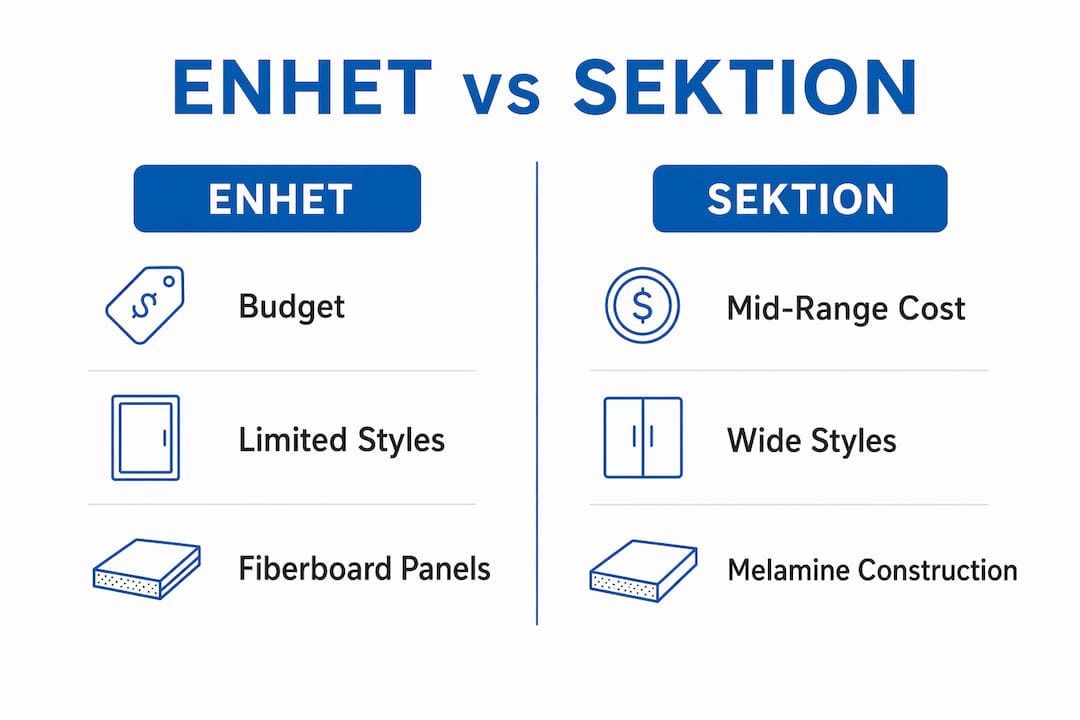
Construction quality is where the two lines diverge most clearly. SEKTION typically uses melamine with plastic edging and fiberboard back panels. ENHET steps down to lower-cost fiberboard with paper filling for sides and bottoms, plus particleboard and MDF in other components. That difference matters most when you’re screwing in new hinges, swapping hardware, or expecting doors to hold up in a high-moisture kitchen.

Many homeowners and reviewers rate IKEA cabinets as less durable than higher-quality RTA or custom options due to these material choices. Paper-filled fiberboard, in particular, strips out faster when hinge screws are removed and re-driven, which is exactly what happens during a refacing project.
Custom doors made from plywood or solid wood hold screws more reliably, resist edge chipping, and perform better when refinished or repainted. For a kitchen that sees daily use, that difference compounds over years.
Practical consequences of the material gap:
- Screw-holding: Particleboard and paper-filled fiberboard strip faster than plywood under repeated hinge adjustments.
- Edge durability: Plastic edging on SEKTION chips less than ENHET’s paper-wrapped edges, but neither matches solid wood or plywood banding.
- Moisture resistance: Both lines are vulnerable to swelling near sinks and dishwashers; custom solid-core doors handle humidity significantly better.
- Refinishing: ENHET’s paper-filled surfaces cannot be repainted reliably; SEKTION’s melamine faces are similarly difficult to refinish without specialty primers.
What style and sizing options do ENHET and SEKTION offer for refacing?
Style range is another meaningful difference. ENHET offers a small number of face styles — white shaker, white flat-front, gray wood shaker, and a wood veneer flat-front. SEKTION spans roughly two dozen face styles with more color contrast options. If you’re refacing to achieve a specific look, SEKTION gives you more to work with out of the box, but neither line comes close to the 30-plus styles and 130-plus colors available through Tdm-thedoormaker.
Sizing compatibility is where homeowners run into the most friction. IKEA’s hinge mounting patterns are proprietary, and ENHET and SEKTION doors are not cross-compatible with each other or with standard American frameless or face-frame cabinet hardware. Overlay dimensions, hinge bore spacing, and cup diameter all need to be verified before you order anything.
Pro Tip: Measure your hinge hole center-to-center distance and the door overlay (how much the door covers the cabinet frame) before ordering custom doors or replacement hardware. A difference of even 2mm in bore spacing can mean a hinge plate won’t seat correctly.
- ENHET and SEKTION use different hinge plate systems — do not assume parts are interchangeable.
- Standard American 35mm hinge cups may fit, but the mounting plate and screw pattern still need verification.
- Overlay dimensions vary by cabinet depth and door size; always measure the actual installed door, not the box opening alone.
Homeowners exploring cabinet styles buyers prefer for renovations consistently rank shaker and flat-front profiles at the top, which both IKEA lines offer in limited versions. Custom doors give you those same profiles in a wider material and finish range.
What should you check before refacing ENHET or SEKTION cabinets?
A methodical approach prevents the most common refacing mistakes. Work through these steps before placing any order.
- Confirm your system. Find the model sticker inside the cabinet box. Note whether it reads ENHET or SEKTION, then record the box depth and interior dimensions.
- Measure door width and height. Measure each door opening individually — IKEA boxes are nominally consistent, but installed dimensions vary.
- Record the overlay. Measure how much the existing door overlaps the cabinet frame on each side.
- Check hinge bore spacing. Open a door and measure center-to-center between the two hinge cup holes. Note the cup diameter.
- Measure drawer front heights. Drawer fronts are sized separately from doors; record each one individually.
- Note jamb and filler strip locations. Identify any filler strips between cabinets or at walls — these affect final door width.
Common pitfalls to anticipate:
- ENHET and SEKTION doors are not interchangeable, even when box dimensions look similar.
- Soft-close hinges require specific plate depths; confirm compatibility before buying a full set.
- Filler strips may need to be adjusted or replaced when switching to custom doors with different overlay dimensions.
- Reveal changes (the gap between adjacent doors) shift when overlay dimensions change.
Pro Tip: Order a sample door and a hinge kit before committing to a full order. Fitting a single door first confirms your measurements and reveals any overlay or bore-spacing issues before they affect the whole kitchen.
For a detailed measurement walkthrough, the DIY kitchen cabinet refacing guide covers tools, tolerances, and how to record dimensions accurately.
How do cost and long-term value compare across ENHET, SEKTION, and custom doors?
ENHET sits at the budget end of the IKEA range, while SEKTION positions closer to mid-to-higher RTA pricing. Custom doors from Tdm-thedoormaker carry a higher upfront cost per door, but the total cost of ownership tells a different story over five to ten years.
Stock ENHET doors on paper-filled fiberboard boxes may need replacement within a few years in a high-use kitchen. SEKTION holds up somewhat better, but its melamine faces still limit refinishing options. Custom plywood or solid-wood doors, by contrast, support hinge re-drilling, hardware swaps, and repainting without degrading the substrate.
Scenarios where custom doors pay off clearly:
- High-use kitchens where cabinet fronts take daily wear from cooking, cleaning, and repeated opening.
- Moisture-prone environments near sinks, dishwashers, or steam-heavy cooking areas.
- Resale-driven remodels where finish quality and style consistency affect perceived home value.
- Homeowners who want a specific style not available in IKEA’s limited door lineup.
Additional cost factors to budget for a refacing project include sample doors, hinge adapters if bore spacing differs, and any carpentry needed to adjust filler strips or reveals. The cabinet refacing cost vs replacing breakdown is a useful reference when building your project budget.
How does installation differ between ENHET and SEKTION?
The installation process for both systems follows IKEA’s standard rail-and-bracket method, but the details diverge in ways that matter for refacing. SEKTION uses a suspension rail system where the cabinet box hangs from a wall-mounted rail, making it easier to level and adjust after installation. ENHET also uses a rail system, but the brackets and adjustment range differ slightly, and the lighter box construction means the system is less forgiving of wall irregularities.
For refacing specifically, the key installation difference is hinge plate compatibility. SEKTION’s UTRUSTA hinge system is more widely documented and has more third-party compatible hardware available. ENHET’s hinge system is less universal, which means sourcing compatible soft-close upgrades or custom door hinges requires more verification upfront. When you’re fitting custom doors, that extra verification step is non-negotiable.
Which system is more eco-friendly, ENHET or SEKTION?
Neither line is a clear sustainability winner, but there are meaningful differences. IKEA has committed to using more recycled and renewable materials across its product range, and both ENHET and SEKTION incorporate some recycled wood fiber content in their particleboard and fiberboard components. SEKTION’s melamine surface is more durable, which means doors are less likely to need early replacement, reducing material waste over time.
ENHET’s paper-filled fiberboard panels use less dense material, which lowers the raw material input per box, but the shorter functional lifespan offsets that advantage. A door or panel replaced every few years generates more waste than one that lasts a decade.
Custom solid-wood or plywood doors from Tdm-thedoormaker, when sourced from responsibly managed forests, offer a longer service life that reduces replacement frequency. Refacing itself is an inherently lower-waste approach than a full cabinet replacement, since the existing boxes stay in place and out of the landfill.
Key Takeaways
For a refacing project, SEKTION outperforms ENHET on materials and style range, but custom doors from Tdm-thedoormaker deliver the durability, precision sizing, and finish variety that neither IKEA line can match.
| Point | Details |
|---|---|
| SEKTION vs ENHET for refacing | SEKTION’s melamine construction and broader style range make it the stronger base for a refacing project. |
| Material limitations of both lines | Both use fiberboard and particleboard cores that limit screw-holding, moisture resistance, and refinishing options. |
| Measure before you order | Confirm hinge bore spacing, overlay, and box depth for each cabinet before ordering doors or hardware. |
| Custom doors extend lifespan | Plywood or solid-wood custom doors support hinge re-drilling and repainting, reducing long-term replacement costs. |
| Tdm-thedoormaker for precision fit | Tdm-thedoormaker’s custom doors are sized to 1/10,000" and available in 30-plus styles and 130-plus colors for IKEA frames. |
Why precision measurement changes everything in a refacing project
Most homeowners underestimate how much the ENHET vs SEKTION distinction matters until they’re holding a door that doesn’t quite fit. The hinge bore is 2mm off, the overlay is wrong, or the filler strip needs trimming. These are solvable problems, but they’re also avoidable ones.
What I’ve seen consistently is that homeowners who measure twice, order a sample, and confirm their hinge system before committing to a full order end up with a refacing result that looks genuinely custom. Those who skip those steps spend more time and money correcting fit issues than the sample door would have cost.
The other thing worth saying plainly: IKEA’s systems are designed for IKEA’s own doors. When you step outside that ecosystem with custom doors, precision sizing isn’t a luxury. It’s what makes the project work without shimming, filler strips, or callbacks. Tdm-thedoormaker’s tolerance of 1/10,000" exists precisely because IKEA’s proprietary hinge patterns and frame reveals don’t leave much room for error. That level of precision is what separates a smooth installation from one that requires a carpenter to fix.
Custom doors for IKEA cabinets: what Tdm-thedoormaker offers
Stock IKEA doors give you a starting point. Tdm-thedoormaker gives you a finished kitchen.
Tdm-thedoormaker makes custom doors for IKEA cabinets sized to 1/10,000" precision, available in over 30 styles and 130-plus colors and finishes. Whether your boxes are ENHET or SEKTION, the three-step process is the same: measure your openings using the online configurator, design your doors by selecting style and finish, then order with hinge hole options pre-drilled to your spec. Sample doors are available before you commit to a full order, which is the lowest-risk way to confirm fit and finish in your actual kitchen.
For homeowners weighing the full cost picture, the cabinet refacing versus full remodel page breaks down where refacing saves money and where it doesn’t. When you’re ready to order, start with the custom cabinet doors online page to configure your doors and get pricing.
Sources and further reading
- IKEA Cabinets Review: What to Know Before Buying — KitchenandBathDIY.com: source for ENHET/SEKTION material specs, face style counts, price positioning, and durability comparisons used throughout this article.
- Section definition — Merriam-Webster: authoritative English-language definition used to ground the unit vs section terminology explanation.
- Section vs. Unit: Which One Is the Correct One? — The Content Authority: plain-English breakdown of how “section” and “unit” differ in writing and organizational contexts.
- What is the difference between a unit and a section? — Stonewood Properties: explains the legal distinction between “unit” and “section” in property/sectional-title contexts, relevant for homeowners in managed properties.
- Measurement checklist and hinge compatibility guidance: Tdm-thedoormaker author expertise, based on common refacing project requirements for IKEA ENHET and SEKTION systems.
- Custom door durability claims: Tdm-thedoormaker author expertise, consistent with widely documented performance differences between paper-filled fiberboard and plywood or solid-wood substrates.