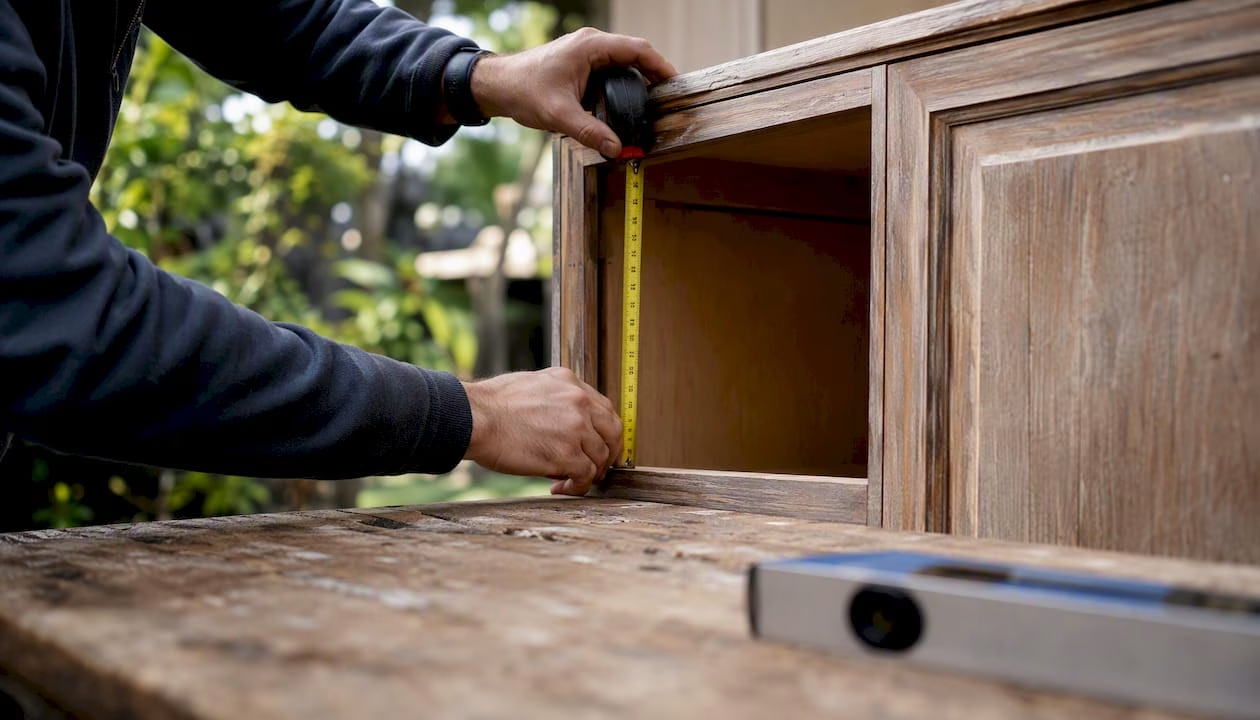
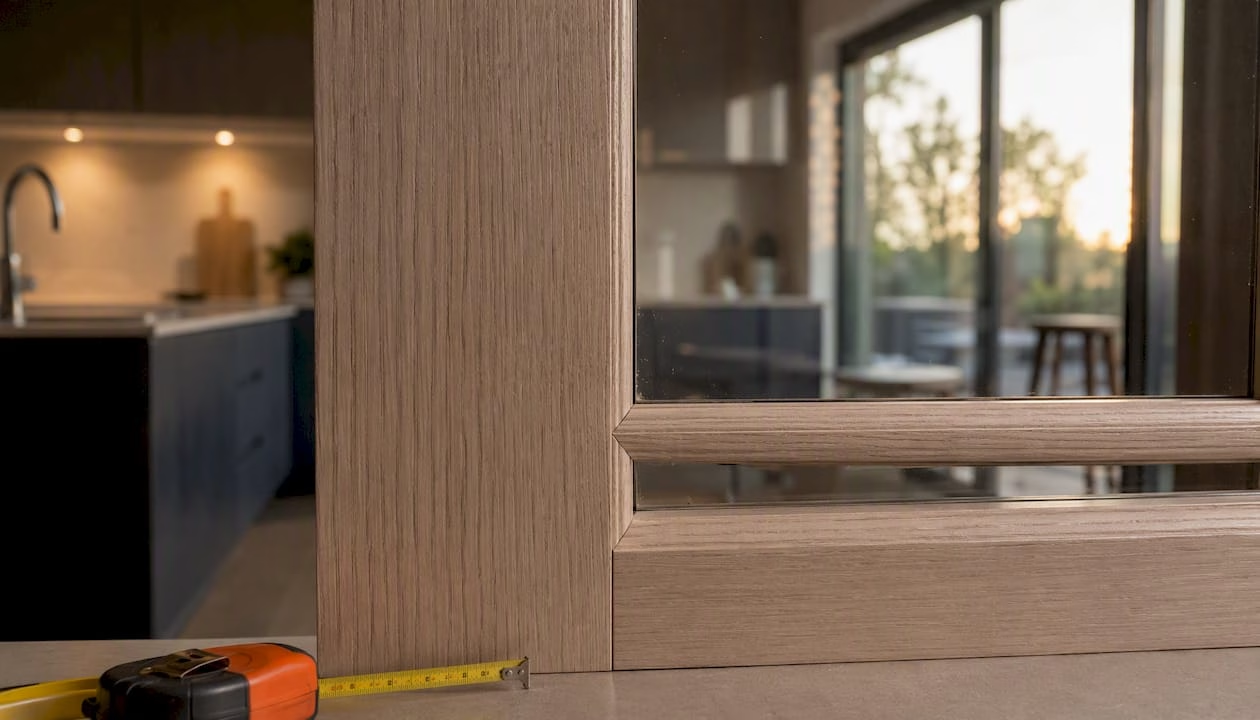
In cabinetry, a mullion is the thicker structural bar or frame element that divides full door openings or creates multi-panel glass doors, while a muntin is the narrower grid bar that subdivides a single glass opening into a divided-lite pattern. For most cabinet refacing projects, the practical choice comes down to this: choose mullions when you want a traditional multi-panel display door with real structural presence, and choose muntins (or applied grille overlays) when you want the divided-lite look on a single pane of glass without the added cost or complexity.
Quick decision triggers:
- Displaying dishware or collectibles: A true mullion door with separate glass openings gives each section its own frame and visual weight.
- Matching existing doors on a budget: An applied muntin grille over single glass replicates the grid look at lower cost and with faster lead times.
- Retrofitting a single glass opening: Muntins or applied overlays are almost always the right call here since true mullion construction requires rebuilding the door frame.
Table of Contents
- What’s the difference between a mullion and a muntin on a cabinet door?
- What materials and profiles work best for cabinet mullions and muntins?
- How do you choose muntins vs mullions for your refacing project?
- How do installation type and overlay style affect compatibility?
- Which mullion and muntin styles suit common cabinet door types?
- Why Tdm-thedoormaker is a reliable choice for custom mullion orders
- Key Takeaways
- What the mullion vs muntin choice really comes down to
- Custom cabinet doors with precision sizing, starting today
What’s the difference between a mullion and a muntin on a cabinet door?
Mullions are the heavier dividers — typically 1.5" to 2.5" wide — that form the structural frame separating distinct glass openings within a door. You can identify them by their thickness relative to the stile and rail: a mullion usually matches or nearly matches the face width of the surrounding frame. At the glass reveal, you will see a full rabbet or stop on each side because each opening holds its own pane.
Muntins are narrower, often 3/8" to 3/4" wide, and they sit over or within a single glass opening to create the appearance of multiple smaller panes. On an applied grille, the muntin simply adheres to the face of the glass; on a true divided-lite door, it sits between separate small panes. Run your finger along the intersection: if the bar is thin and the glass behind it is continuous, you are looking at a muntin or applied grille. If the bar is thick and each section of glass is independently seated, that is a mullion.
| Feature | Mullion | Muntin / Applied Grille |
|---|---|---|
| Typical face width | 1.5"–2.5" | 3/8"–3/4" |
| Glass arrangement | Separate panes per opening | Single pane (or true divided lite) |
| Structural role | Frames and divides openings | Decorative grid only |
| Finish edge | Full rabbet on each side | Thin profile, minimal reveal |
| Best visual ID | Matches stile/rail thickness | Noticeably thinner than frame |
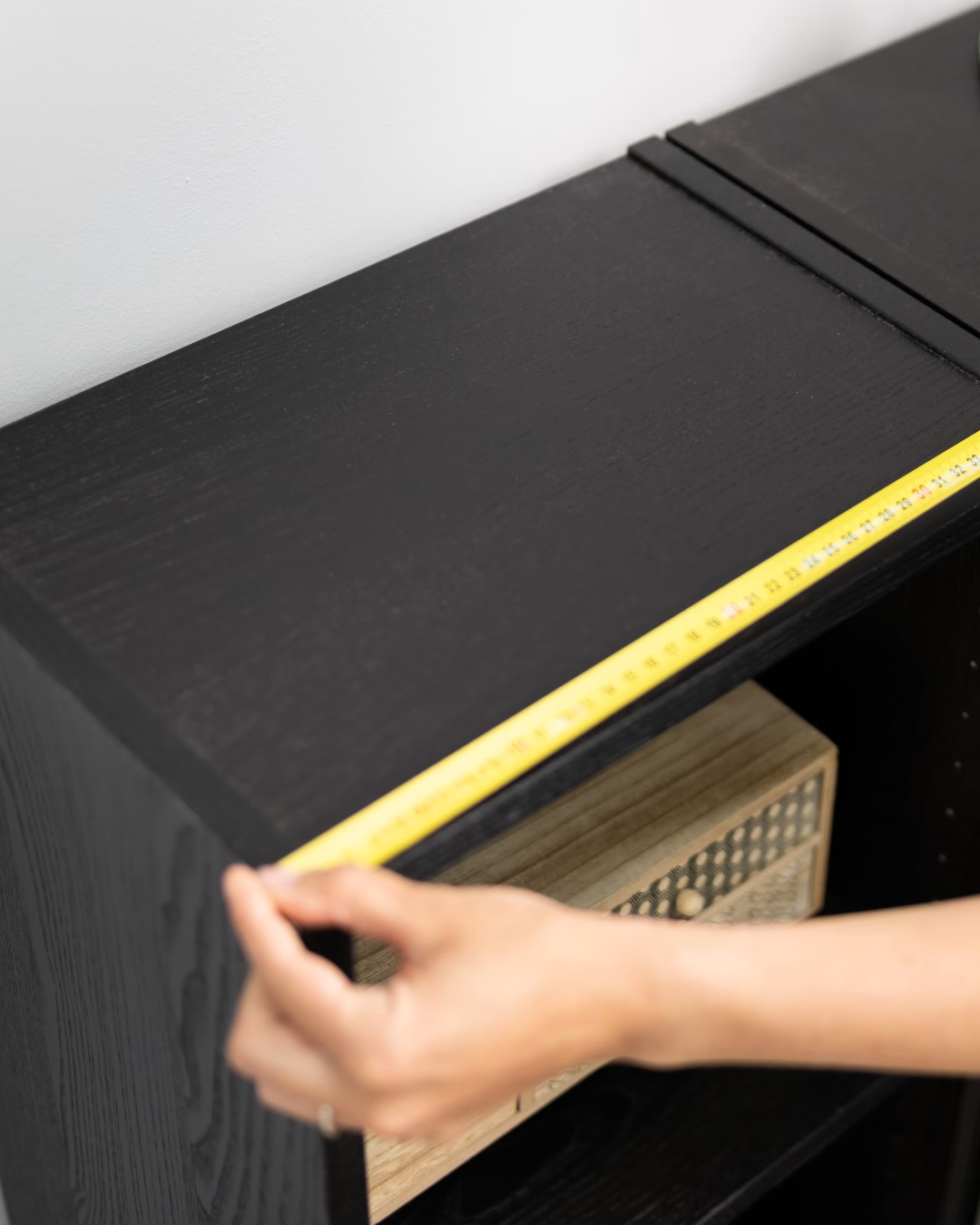
Pro Tip: Photograph your existing door flat against a white wall before ordering. The contrast makes it easy to measure bar widths accurately and confirm whether you have a mullion frame or an applied grille.
What materials and profiles work best for cabinet mullions and muntins?
Mullion options range across materials and styles, and the right choice depends on whether the door will be painted, stained, or left natural.
| Material | Durability | Paintability | Stainability | Cost Tier | Best Use |
|---|---|---|---|---|---|
| Solid wood | High | Good | Excellent | Higher | Stained traditional doors |
| MDF | Moderate | Excellent | Poor | Lower | Painted display doors |
| PVC/Vinyl | High | Good | Poor | Moderate | Humid environments |
| Aluminum/Metal | Very high | Powder coat only | N/A | Higher | Modern/industrial style |
Solid wood mullions accept stain evenly and hold routed profiles cleanly, making them the standard for raised-panel or traditional shaker doors. MDF is the go-to for painted doors because it takes primer and paint without grain telegraphing through the finish. For kitchens near a sink or in high-humidity spaces, PVC holds up where wood or MDF might swell over time. Aluminum suits flat-panel modern doors where a thin, precise line is the point.

Profile shapes matter too. A flat or pencil-bead profile reads as contemporary; an ogee or cove profile signals traditional cabinetry. Face width affects visual scale: a 2" mullion on a small upper cabinet can feel heavy, while a 3/4" muntin on a tall pantry door can look too delicate.
How do you choose muntins vs mullions for your refacing project?
The decision framework is straightforward once you know what the door needs to do.
- Budget and schedule: Applied muntin grilles are the fastest, most affordable path to the divided look. DIY refacing guidance consistently recommends them for projects where matching the existing style matters more than construction authenticity.
Pro Tip: For refacing projects where you are replacing only some doors, an applied grille on single glass is almost always the better match for existing cabinetry. True mullion construction changes the door’s profile depth, which can create a visible mismatch at adjacent doors.
How do installation type and overlay style affect compatibility?
Applied mullions over single glass are the most flexible option for refacing because they do not change the door’s structural depth or hinge requirements. True mullion frames, by contrast, add depth at the glass reveal and may require adjusting hinge backset or using a different hinge cup size.
| Construction Type | Compatible Door Types | Hinge Style | Glass Options |
|---|---|---|---|
| Applied grille (overlay) | Full overlay, half overlay | Any concealed or surface hinge | Single pane only |
| True mullion frame | Inset, face-frame | Concealed or butt hinge | Separate panes per opening |
| Insert mullion | Full overlay, inset | Concealed hinge | Single pane or divided lite |
| Retrofit mullion insert | Existing single-glass door | Existing hinges (no change) | Single pane only |
Quick installer checks before ordering:
- Confirm hinge cup clearance: a thicker mullion bar near the hinge side needs at least 3mm of clearance from the cup edge.
- Check edge-banding requirements: MDF mullions on painted doors need edge banding on all exposed edges to prevent moisture absorption.
- Verify backset depth: true mullion frames typically add 3/8"–1/2" to the door’s overall depth.
Which mullion and muntin styles suit common cabinet door types?
Matching the grid treatment to the door style is what makes a refacing project look intentional rather than assembled.
- Raised-panel door + traditional solid mullion frame (1.5"–2" face width): Traditional mullion frames suit raised-panel doors because the heavier bar matches the visual weight of the panel profile.
- Glass display door + 6-lite or 8-lite true divided-lite mullion: — For upper cabinets meant to display dishware, a multi-lite mullion door with separate panes gives each shelf its own visual frame.
Pro Tip: Request sample doors in two different face widths before finalizing. The difference between a 1/2" and a 3/4" bar looks small on paper but reads very differently at kitchen scale. Matching the interior door style of the room also helps anchor the cabinet choice.
Why Tdm-thedoormaker is a reliable choice for custom mullion orders
Tdm-thedoormaker’s three-step process (measure, design, order) is built specifically for refacing projects where precision and consistency matter. The configurator accepts measurements to 1/10,000", which eliminates the fit issues that come from rounding to the nearest 1/8". Doors arrive with predrilled hinge holes when specified, so installation is straightforward.
The mullions and frames product category covers multiple materials and profiles, and the glass doors with mullions page shows real style examples you can use as visual references when specifying your order.
Key capabilities:
- Precision sizing to 1/10,000" via the online configurator.
- Sample doors and color swatches available before full production.
- Predrilled hinge holes included when specified.
- Over 30 door styles and 130+ colors and finishes.
- Fast turnaround with competitive pricing.
Pro Tip: Use Tdm-thedoormaker’s video tutorials alongside the configurator the first time you place an order. They walk through hinge hole placement and overlay specification in detail, which saves back-and-forth with the support team.
Key Takeaways
Mullions divide full openings structurally; muntins (or applied grilles) subdivide a single glass pane decoratively, and choosing correctly before ordering prevents the most common refacing rework.
| Point | Details |
|---|---|
| Mullion vs muntin defined | Mullions are thicker structural dividers (1.5"–2.5" wide); muntins are narrow grid bars (3/8"–3/4") over a single pane. |
| Material by finish type | Use MDF for painted doors, solid wood for stained doors, PVC for humid spaces, and aluminum for modern flat-panel styles. |
| Applied grille advantage | Applied grilles replicate the divided look on single glass at lower cost and shorter lead times, ideal for most refacing projects. |
| Measure to spec | Record full door dimensions to 1/10,000", glass opening sizes, overlay style, and hinge locations before ordering. |
| Tdm-thedoormaker ordering | Use the configurator for precision sizing, request a sample door to confirm profile and finish, and specify hinge holes upfront. |
What the mullion vs muntin choice really comes down to
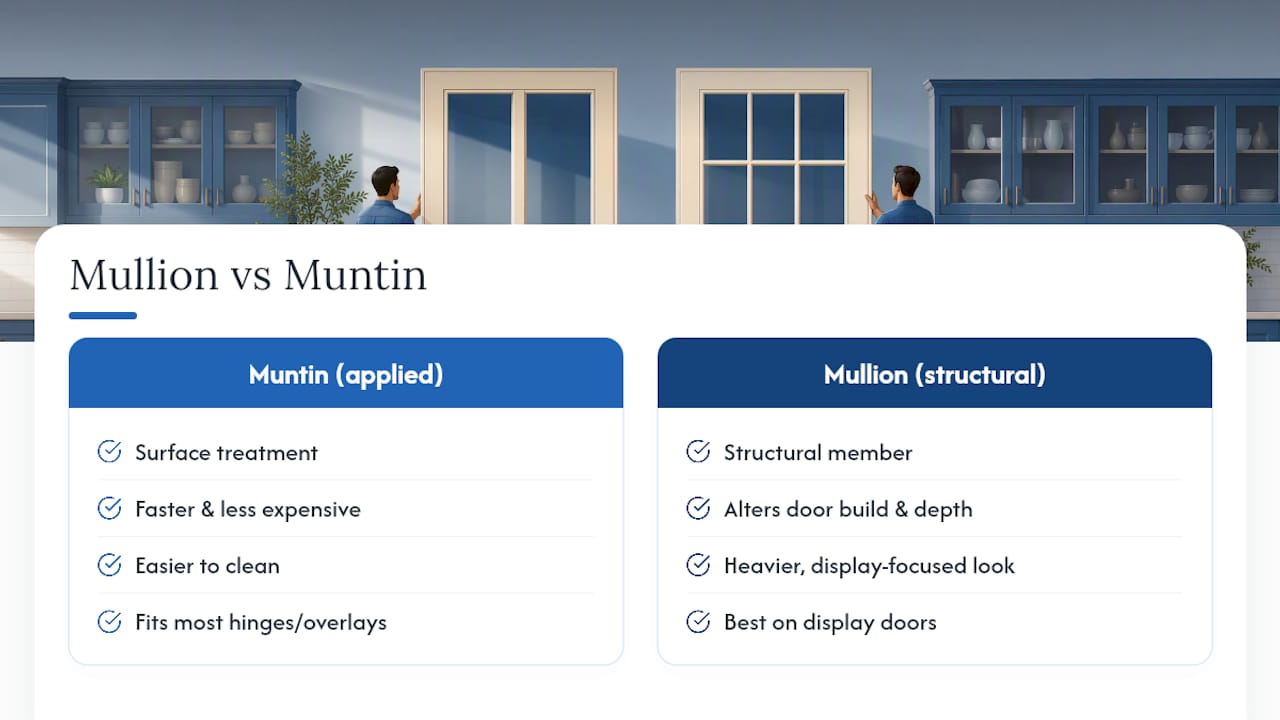
Most of the confusion around mullions and muntins comes from treating them as interchangeable style options when they are actually different construction decisions. A muntin or applied grille is a surface treatment. A mullion is a structural commitment that changes how the door is built, how deep it sits, and how the glass is held. Getting that distinction wrong at the ordering stage is what leads to doors that do not fit, hinges that bind, or a grid that looks out of scale with the rest of the kitchen.
The practical takeaway: for the majority of refacing projects, an applied grille on single glass is the right answer. It is faster, less expensive, easier to clean, and compatible with virtually any hinge and overlay configuration. True mullion construction earns its place on display doors where the architectural weight of a divided frame is the point, particularly on traditional or transitional kitchens where the door is meant to be noticed.
What tends to get overlooked is scale. A 3/8" muntin bar on a tall pantry door reads as a scratch. A 2" mullion on a small upper cabinet reads as a wall. Spending five minutes with a sample door at kitchen scale before committing to a full order is the single most effective way to avoid a result that looks slightly off without anyone being able to say exactly why.
Custom cabinet doors with precision sizing, starting today
Tdm-thedoormaker takes the complexity out of ordering custom mullion and muntin doors for refacing. Instead of guessing at profiles and hoping the finish matches, you measure once using the step-by-step configurator, choose from over 30 styles and 130+ colors, and order doors sized to 1/10,000" precision with hinge holes predrilled.

The sample door program means you can confirm the exact profile depth, finish color, and glass reveal against your existing cabinetry before a single production door is cut. Fast turnaround and pricing that undercuts larger retailers make it a practical choice for both homeowners and contractors managing multiple refacing jobs.
Start your project at the DIY cabinet refacing guide, or go straight to the custom ordering process to configure your doors now. If you want to see how glass doors with luxury grille details translate into a finished kitchen, that context can help you finalize your style choice before you order.