
Tempered glass is significantly stronger than annealed glass because rapid heating and cooling lock compressive stress into its surface, and it breaks into small, rounded pieces instead of sharp shards. Annealed glass is the standard, slow-cooled glass that can be cut and drilled after production but offers no safety advantage when it breaks. Choose tempered wherever impact or fall risk exists, and reserve annealed for fabrication flexibility or optical precision.
TL;DR:
- Tempered glass is much stronger than annealed glass due to surface compression from rapid cooling, making it ideal for impact-prone applications.
- Fabrication of tempered glass requires finalizing all cuts and shaping before tempering; cutting or drilling after causes shattering, increasing lead times.
- Annealed glass offers superior optical clarity and fabrication flexibility but breaks into large, sharp shards, not meeting safety codes in impact-risk areas.
- In case of breakage, annealed glass shatters into dangerous shards, whereas tempered glass fragments into small, blunt pieces for safety.
- Chemical toughening provides an alternative to thermal tempering, especially useful for thin or oddly shaped glass, but is less common and more expensive.
Table of Contents
- What Is Annealed Glass and Where Does It Work Best?
- How Is Tempered Glass Made: Thermal and Chemical Toughening
- How Much Stronger Is Tempered Glass Than Annealed?
- What Happens When Each Type of Glass Breaks?
- Fabrication Rules Every Installer Should Follow
- How Do You Choose Between Tempered, Annealed, or Laminated Glass?
- Why the Tempering Debate Matters for Cabinet Glass
- Order Glass-Ready Cabinet Doors Without the Guesswork
- Sources
- FAQ
What Is Annealed Glass and Where Does It Work Best?
Annealed glass is the baseline product every other type of flat glass starts from. Manufacturers cool it slowly and evenly after forming, which relieves internal stress rather than locking it in. That slow cool is exactly why annealed glass remains so workable: you can cut, drill, sand, and polish it after the fact without triggering the kind of catastrophic failure that plagues tempered panels cut too late.
That workability comes with a tradeoff. Annealed glass breaks into large, jagged shards when it fails, so it carries no built-in safety classification. But for jobs where nobody’s leaning on the glass or falling into it, that tradeoff barely matters, and the flatness and optical clarity annealed glass holds onto make it the better pick.
Annealed glass tends to show up in:
- Picture frames and decorative glazing where the piece never faces impact loads
- Laminated assemblies, where the annealed layer gets sandwiched with an interlayer for strength
- Optical-critical uses like display cases and mirrors, where tempering’s slight distortion is unacceptable
- Cabinet door inserts and interior panels that need custom cutouts or beveled edges after the glass leaves the factory
If your project needs a hole drilled for a handle, a curved edge, or a shape no catalog size covers, annealed glass gives your fabricator room to work.
How Is Tempered Glass Made: Thermal and Chemical Toughening
Tempered, or toughened, glass starts as ordinary annealed glass and gets transformed through controlled thermal shock. The process is precise enough that skipping a step, or doing them out of order, ruins the pane entirely.
- Heat the glass past its transition point. Fabricators heat the pane to roughly 620°C, well above the point where the glass softens, in a tempering furnace.
- Quench it rapidly. High-pressure air jets cool the surface almost instantly while the core stays hot, and that mismatch is what locks compressive stress into the surface as the interior finishes cooling more slowly.
- Let the stress profile stabilize. The finished pane carries compression at the surface and tension at the core, a balance that gives tempered glass both its strength and its shattering pattern.
Chemical toughening takes a different route. Instead of heat, fabricators submerge the glass in a potassium nitrate bath, where an ion-exchange process swaps smaller sodium ions in the glass surface for larger potassium ions. That swap compresses the surface layer without the thermal shock, which makes chemical toughening useful for thin glass or oddly shaped pieces that would warp or crack under a furnace-and-quench cycle. It costs more and shows up far less often in standard architectural glazing.
Both methods share one hard rule: fabrication has to happen before tempering, never after. Once the stress profile sets, cutting or drilling releases that stress instantly, and the pane doesn’t crack, it explodes. That sequencing adds lead time to custom orders, since fabricators need exact final dimensions locked in before the piece ever goes near a furnace.
How Much Stronger Is Tempered Glass Than Annealed?
Tempered glass is commonly cited as significantly stronger than annealed glass(https://en.wikipedia.org/wiki/Tempered_glass) of the same thickness, a gap that comes almost entirely from the surface compression baked in during quenching. That compressive layer has to be overcome before a crack can even start propagating, which is why tempered panels absorb impacts and thermal swings that would shatter an annealed sheet of the same size.
Fully tempered 6mm glass typically needs a minimum surface compression around 69 MPa to qualify as safety glass under common industry benchmarks, a threshold that manufacturers test directly because surface compression correlates closely with both strength and fragmentation pattern.
That MPa figure isn’t just a lab number. It’s the line between a pane that shatters into small, rounded pieces on failure and one that doesn’t meet safety glazing standards at all.
A few other measurable differences matter when you’re comparing specs sheet to specs sheet:
- Tempered glass tolerates far larger temperature differentials across its surface before cracking, which matters for glazing exposed to direct sun next to shaded frame edges.
- Annealed glass’s practical strength depends heavily on edge condition. Surface flaws and micro-chips propagate cracks far more readily in annealed glass than in tempered, where the compressive skin resists crack initiation.
- Bending strength, not just impact resistance, scales with that same 4x multiplier, which is why tempered glass shows up in structural glazing and wind-load-prone façades.
None of this makes annealed glass “weak” in an absolute sense. It performs fine under the loads it’s designed for. The strength gap only becomes a safety issue once impact, thermal cycling, or foot traffic enters the picture, which is exactly the scenario building codes are written around.
What Happens When Each Type of Glass Breaks?
The difference between tempered vs annealed glass matters most at the moment of failure, and it’s not subtle. Annealed glass breaks into large, jagged shards with edges sharp enough to cause deep lacerations, because the crack simply follows whatever path the impact force created. Tempered glass, once its stressed surface layer is breached, releases all that stored energy at once and fragments into small, roughly cubical pieces with blunt edges. That granular breakage pattern is the entire reason tempered glass earns its “safety glass” designation, and it’s why building codes lean on it so heavily.
Codes and industry guidance typically call for tempered or laminated safety glazing in:
- Entry doors, storm doors, and any glazed door panel near floor level
- Shower and tub enclosures, where wet feet and close impact risk collide
- Sidelights and low glazing near stairs, landings, or floor-level windows
- Glazed partitions and railings in commercial and residential settings
Laminated glass, which sandwiches an interlayer (usually PVB) between two glass sheets, becomes the safer choice specifically where a broken pane still needs to hold together after impact, like overhead skylights or glass balustrades with fall exposure. Tempered glass resists breaking better up front, but once it fails, it fails completely and drops out of the frame. Laminated annealed glass can crack and still stay put.
Most field failures don’t come from random bad luck. Three causes account for the overwhelming majority: edge damage from a chip during installation, nickel sulfide inclusions that expand slowly inside the glass and cause spontaneous breakage months or years later, and uneven thermal stress from partial shading or HVAC drafts hitting one section of a pane.
Pro Tip: If you’re specifying glass for anything overhead, a skylight, a glass shelf above head height, or a railing infill, ask specifically about laminated tempered glass rather than tempered alone. You get the impact resistance and the post-breakage retention in one assembly.
Fabrication Rules Every Installer Should Follow
Getting tempered glass right on-site comes down to respecting one sequence: everything gets shaped before the furnace, nothing gets shaped after.
- Finalize every cutout before tempering. Holes for hinges, cutouts for hardware, and edge profiles all need to happen while the glass is still annealed, since tempered glass cannot be cut, drilled, or ground without shattering.
- Specify edge treatment up front. Polished, seamed, or beveled edges reduce the microscopic flaws that concentrate stress, and edge quality directly affects how likely a pane is to fail in service years down the line.
- Handle and store panels on edge, never flat. Flat stacking concentrates weight on lower panes and invites edge chipping during transport.
- Use corner protectors and A-frame racks during shipping. A single corner impact during delivery can create a flaw that triggers spontaneous breakage weeks later.
- Treat any chip or crack as a replacement issue, not a repair job. Tempered glass can’t be reworked once damaged; the stress profile that made it strong is exactly what makes a compromised pane unpredictable.
Annealed glass gives you far more room for error here, since a fabricator can adjust a cutout or re-polish an edge without starting over. That flexibility is worth factoring in before you commit a design to tempered stock.
How Do You Choose Between Tempered, Annealed, or Laminated Glass?
Run through a short list of project questions before specifying anything, because the right answer changes fast depending on where the glass sits and what it touches.
- Will people or pets be near this glass at floor level, in a door path, or within reach of impact? That points toward tempered.
- Does the piece need custom holes, cutouts, or edge shaping after the initial order? Lean annealed, or plan the cutting before tempering.
- Is optical flatness critical, like a mirror, display case, or feature panel viewed up close? Annealed avoids the slight bowing tempering introduces.
- Is there fall exposure if the pane breaks, such as overhead glazing or a railing infill? Laminated glass, tempered or annealed, keeps fragments contained.
- Does the project face heavy thermal swings, direct sun on part of the pane, or wide temperature differentials? Tempered handles that stress far better.
| Scenario | Recommended glass | Why |
|---|---|---|
| Shower enclosure | Tempered | Code-mandated safety glazing near wet, high-traffic areas |
| Cabinet door inserts | Annealed or tempered | Depends on cutout needs versus impact exposure |
| Storefront/entry door | Tempered | Impact resistance and code compliance for public traffic |
| Overhead skylight | Laminated | Retains fragments after breakage; fall protection |
| Display case or mirror panel | Annealed | Optical flatness with no distortion |
Budget and lead time follow the same logic. Annealed glass is faster and cheaper to fabricate custom shapes for, while tempered glass typically adds cost and turnaround time because dimensions must be finalized before tempering begins.
Why the Tempering Debate Matters for Cabinet Glass
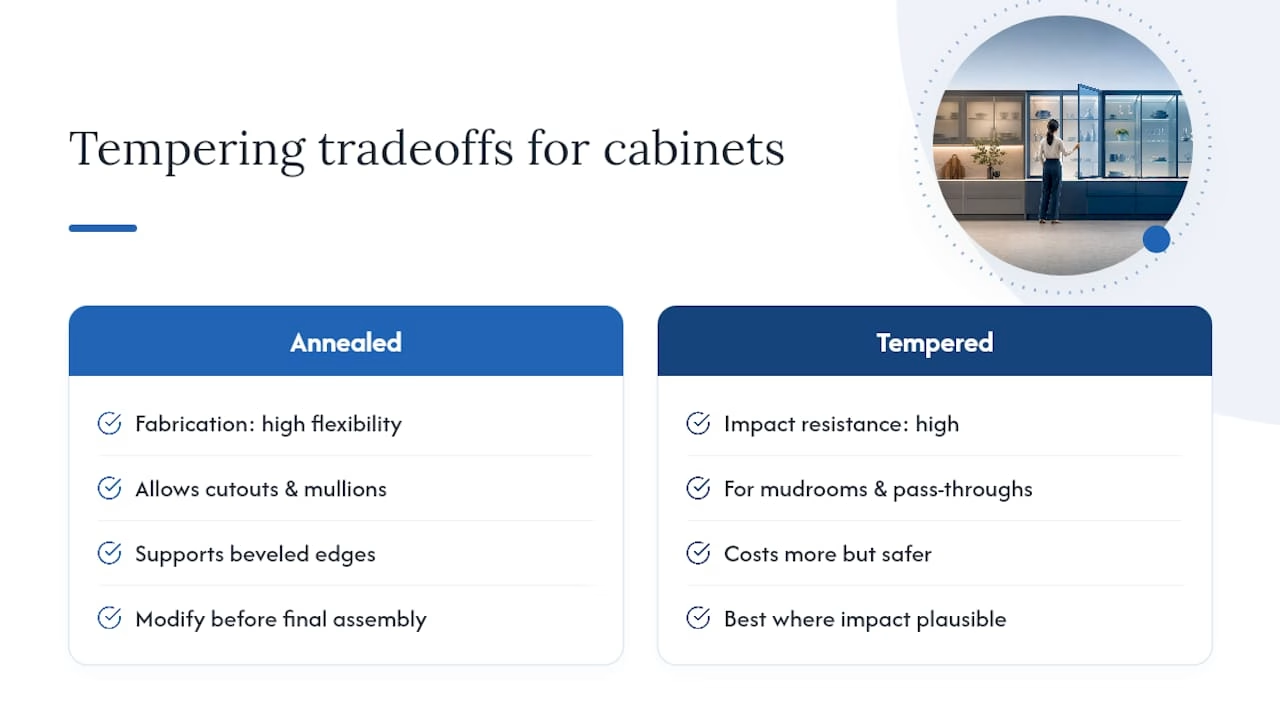
Cabinet door glass rarely faces the fall risk that drives most tempered vs annealed decisions, but the same tradeoffs still apply. If a design calls for custom cutouts, mullions, or a beveled edge, annealed glass gives a fabricator more room to work before final assembly. If the doors sit somewhere impact is plausible, a mudroom, a busy kitchen pass-through, tempered earns its cost.
Tdm-thedoormaker’s guide to cabinet glass frame options and its breakdown of glass alternatives for custom cabinet doors both dig into how these material choices play out in real kitchens. Worth a look before you finalize a design.
— David
Order Glass-Ready Cabinet Doors Without the Guesswork
Tdm-thedoormaker gets you a custom, glass-ready cabinet door without the markup a full cabinet replacement or a big-box retailer charges. The process runs in three steps: measure your openings, design the door style and finish, and order with sizing precision.

If tempered’s fabrication constraints or annealed’s optical limits have you reconsidering glass altogether, Tdm-thedoormaker’s custom cabinet doors glass alternatives page covers options like acrylic and textured panel inserts that sidestep the tempering-versus-annealing tradeoff entirely. And if glass is still the plan, the glass-ready doors lineup is built specifically to accommodate your panel choice with hinge holes and sample doors available before you commit. For homeowners who’d rather see a real design example first, One Day Doors & Closets has a solid write-up on glass interior door styling worth a browse. Ready to see pricing on your own cabinets? Start your custom order and get a quote based on your exact measurements.
Sources
The Wikipedia entry on tempered glass backs the manufacturing steps and strength figures throughout this piece. Vetrotech’s tempered vs annealed comparison supports the code and safety-application section. LCI’s technical note on tempered glass bowing informs the optical distortion discussion, and the fracture mechanics chapter grounds the edge-damage and failure-mode analysis.
FAQ
Is Tempered Glass Better Than Annealed Glass?
Neither is universally “better.” Tempered glass wins on impact resistance, bending strength, and safety after breakage, while annealed glass wins on fabrication flexibility and optical flatness for cutouts, edges, and display-quality clarity.
What Are the Disadvantages of Annealed Glass?
Annealed glass breaks into large, sharp shards that pose real injury risk, and it can’t meet building code requirements for safety glazing in doors, showers, and low-level windows without lamination or tempering added.
How Can You Tell if Glass Is Tempered or Annealed?
Tempered glass usually carries an etched manufacturer’s logo or certification mark in a corner, and viewing it through polarized sunglasses often reveals a faint dark, mottled stress pattern that annealed glass doesn’t show.
What Is the Difference Between Annealing and Tempering Glass?
Annealing is the slow, controlled cooling every glass sheet goes through to relieve internal stress during manufacturing, while tempering is a separate, later process that reheats finished annealed glass and quenches it rapidly to lock in surface compression and strength.