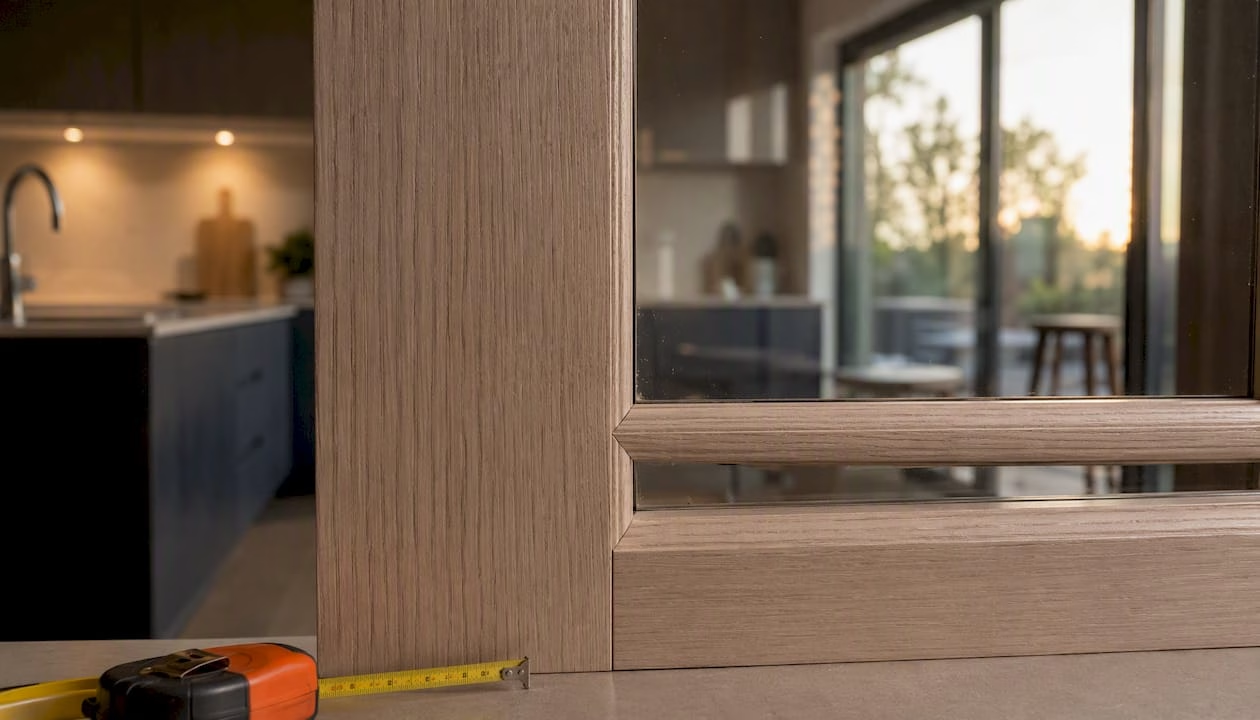
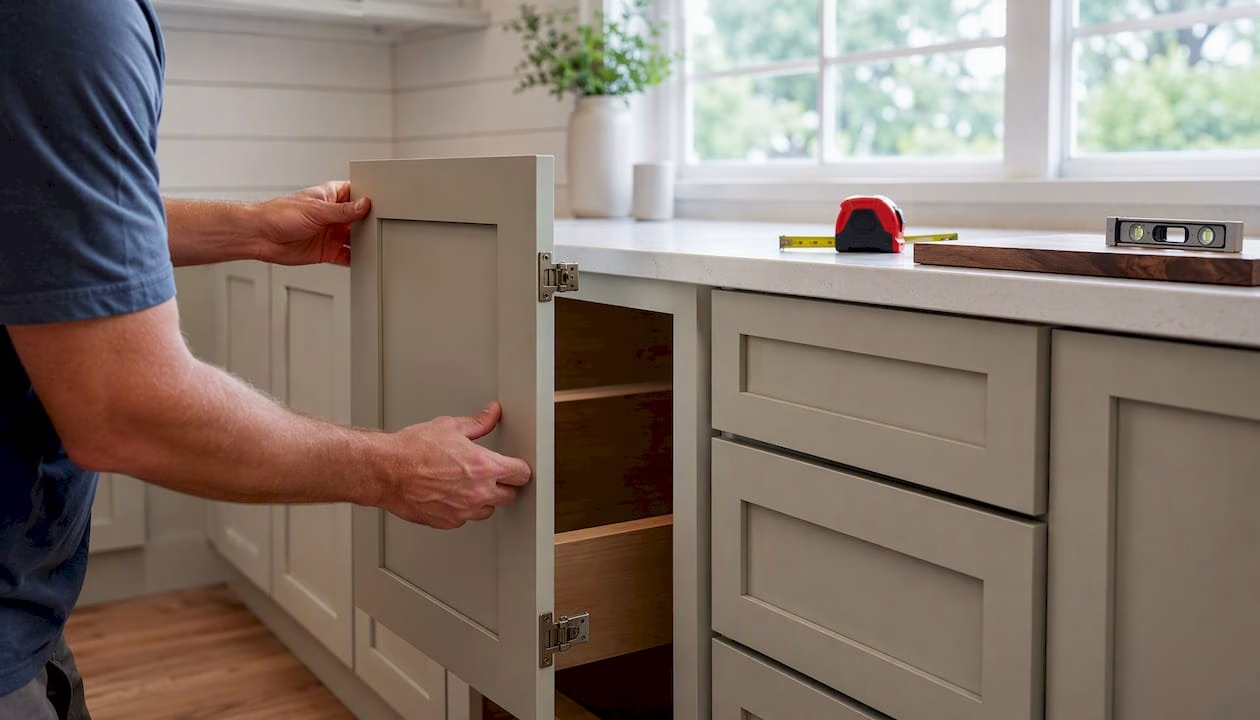
Cabinet refacing is the right move for a small kitchen when your cabinet boxes are structurally sound and your layout works. You get a fresh, cohesive look in a fraction of the time and cost of a full replacement, with refacing typically running 30–50% less than new cabinets and completing in 3–5 days for a standard kitchen. Before you commit, do one thing: press firmly on every cabinet box panel and shelf. If anything feels soft, spongy, or bowed, stop and read the caveats section first.
Quick-reference checklist:
- Cabinet boxes are firm, square, and dry? Refacing is likely your best path.
- Layout works for how you cook? No need to move appliances or walls.
- Budget in the $4,000–$15,000 CAD range? That covers most small-kitchen refacing projects.
- Timeline: most small kitchens are done in 2–4 days with minimal disruption to your home.
- Next step: order a sample door in your chosen finish before placing a full order.
Key Takeaways
| Point | Details |
|---|---|
| When refacing works | Boxes are firm and dry, layout is functional, and budget is $4,000–$15,000 CAD. |
| Design choices that open space | Flat or shallow-profile doors, light finishes, and low-contrast hardware reduce visual clutter and make small kitchens feel larger. |
| Cost and timeline | Most small-kitchen refacing projects in Canada land between $5,000 and $9,000 CAD and complete in 2–5 days. |
| Inspect before you commit | Press on every cabinet panel and shelf before ordering; soft or bowed boxes disqualify a kitchen from refacing. |
| Tdm-thedoormaker | Offers precision-cut custom doors in 30+ styles and 130+ finishes with sample availability, ordered online in three steps. |
Table of Contents
- Why does small kitchen refacing deliver such high visual impact?
- Which door styles make a small kitchen feel larger?
- How do hardware and lighting help a small kitchen read larger?
- What storage upgrades pair best with a small-kitchen refacing?
- What materials are used in refacing, and what does the process look like?
- What does small-kitchen refacing cost in Canada, and what moves the price?
- When should you NOT reface your small kitchen?
- How do you choose materials and a supplier for your refacing project?
- A practical perspective on small-kitchen refacing
- The Door Maker makes custom refacing straightforward for small kitchens
- Sources
Why does small kitchen refacing deliver such high visual impact?
In a compact kitchen, every surface you see is a cabinet. There is no sprawling island or long stretch of countertop to draw the eye away. That concentration of cabinetry means a refacing job, which replaces doors, drawer fronts, and veneers the exposed cabinet faces without touching the layout, changes the entire character of the room in one move.
Designers consistently point to design cohesion as one of the most powerful tools in a small kitchen: when cabinet finishes, walls, and backsplash share a close tonal relationship, the eye reads the room as one unified space rather than a series of competing surfaces. That reduction in visual contrast makes the kitchen feel noticeably larger without moving a single wall. Refacing is the most direct way to achieve that cohesion because it lets you control every visible cabinet surface at once.
The practical case is just as strong. You can explore the reasons to reface your cabinet doors in detail, but the short version is this: no demolition, no new plumbing or electrical, no weeks of a gutted kitchen. For a household that depends on that kitchen daily, that matters.
| Factor | Refacing | Full replacement |
|---|---|---|
| Typical cost (CAD) | $4,000–$15,000 | $4,000–$15,000 |
| Timeline | 2–5 days | 3–6 weeks |
| Layout change | No | Yes |
| Disruption level | Low | High |
| Best when | Boxes are sound, layout works | Boxes damaged or layout must change |
Refacing typically costs 30–50% less than full cabinet replacement and is completed in days, not weeks, making it one of the most cost-efficient upgrades available for a small kitchen.
Which door styles make a small kitchen feel larger?
The door profile you choose does real work in a tight space. Flat-panel or slab doors are the strongest choice for visual simplicity: no raised edges, no shadow lines, nothing to fragment the surface. A run of slab doors in a soft white or warm greige reads as one continuous plane, which is exactly what you want. Shallow-profile shaker doors are a close second. The recessed center panel adds just enough definition to feel intentional without the visual weight of a traditional raised-panel style.

Glass inserts, used selectively on one or two upper cabinets, create depth by letting the eye travel past the door surface. They work especially well when the interior is lit or kept tidy. Avoid covering every upper cabinet in glass; the effect reverses when the inside looks cluttered.
For finishes, lighter tones and satin sheens are the most reliable performers in small kitchens. High-gloss surfaces reflect light and can increase perceived depth, but they also show every fingerprint and surface imperfection, which is worth factoring in if your kitchen gets heavy daily use. A two-tone approach, where lower cabinets carry a slightly deeper tone and uppers stay light, draws the eye upward and makes ceilings feel higher.
Material options and their fit for small kitchens:
- Painted MDF doors: Consistent color, no grain variation, takes paint well, and holds up in moderate humidity. A practical choice for most Canadian kitchens.
- Thermofoil: A PVC film heat-pressed over MDF. Smooth, easy to clean, and available in a wide color range. Can lift at edges near heat sources over time, so placement near the range matters.
- Wood veneer: Real wood character with less movement than solid wood. Works well in kitchens with controlled humidity. Requires periodic maintenance.
- Laminate: Durable, moisture-resistant, and available in many finishes including wood-look options. A strong choice for high-traffic small kitchens.
Pro Tip: Order a physical sample door in your top two finish choices and live with them in your kitchen for 48 hours before placing your full order. Kitchen lighting, especially the mix of natural and under-cabinet light, changes how a finish reads dramatically from morning to evening.
How do hardware and lighting help a small kitchen read larger?
Hardware scale is easy to get wrong in a small kitchen. Oversized pulls on narrow cabinet doors look heavy and draw attention to how little space there is. For doors under 18 inches wide, a 96mm (roughly 3.75-inch) bar pull or a small round knob keeps proportions clean. On drawer fronts, a single centered pull works better than two knobs, which can make a standard drawer look busier than it is.
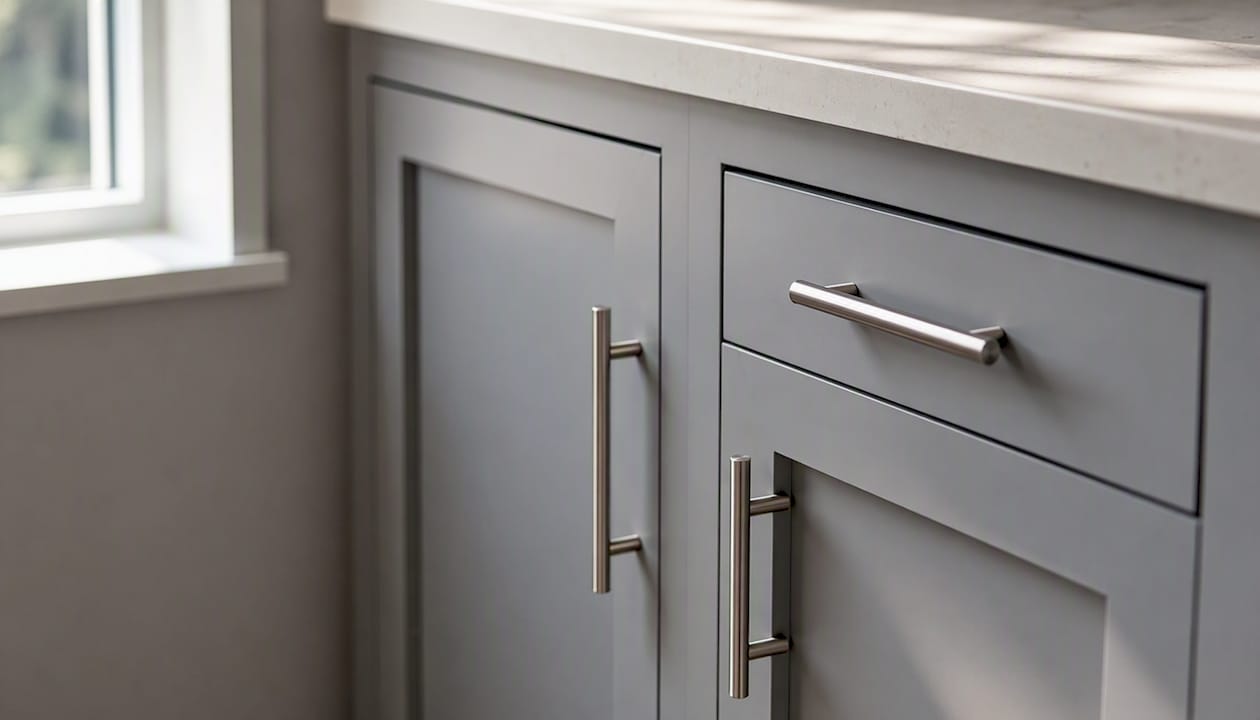
Finish coordination between hardware and cabinets reduces visual clutter more than most homeowners expect. When the hardware finish sits close to the cabinet finish in tone (brushed nickel on a cool gray, matte black on a deep navy, warm brass on a creamy white), the hardware recedes slightly and the cabinet surface reads as one piece. High-contrast hardware, like polished chrome on a dark cabinet, pulls the eye to every individual door and fragments the run.
Lighting layers matter as much as any finish choice. Under-cabinet task lighting eliminates the shadow that standard overhead fixtures cast across the counter, which makes the work surface feel open rather than cramped. A warm-white LED strip (2700K–3000K) under upper cabinets, combined with a central overhead fixture, removes the flat, shadowy quality that makes small kitchens feel smaller. If your budget allows one lighting upgrade alongside a refacing project, under-cabinet LED strips are the highest-return option.
What storage upgrades pair best with a small-kitchen refacing?
A refacing project is the ideal moment to address storage because the cabinet fronts are already coming off. These upgrades, ranked by impact per dollar spent, work with your existing boxes:
- Deep drawer conversion for lower cabinets. Replacing a lower cabinet’s fixed shelf and door with two or three deep drawers gives you full-depth access to everything inside. Pots, pans, and dry goods that disappear into the back of a shelf become visible and reachable. This is consistently the highest-impact storage upgrade in a small kitchen.
- Pull-out trays inside base cabinets. If full drawer conversion is outside the budget, retrofitted pull-out trays on full-extension slides achieve most of the same benefit. They fit inside existing boxes without structural changes.
- Vertical dividers for baking sheets and cutting boards. A simple set of vertical dividers in one base cabinet keeps flat items upright and accessible. The cost is low and the daily convenience is significant.
- Slim pantry pull-outs. A 6–9 inch pull-out pantry column beside the refrigerator or at the end of a cabinet run uses otherwise dead space for canned goods, spices, and small appliances.
- Tray dividers in upper cabinets. Upper cabinet tray dividers keep serving platters and sheet pans from stacking into an unstable pile that requires unpacking to reach the bottom item.
Small-kitchen makeovers show consistently that storage planning and opening sightlines deliver as much perceived-space improvement as any finish change. If you find that your storage problems are structural, such as boxes that are too shallow for standard pull-outs or a layout that puts the refrigerator where a pantry column needs to go, that is a signal that partial replacement may serve you better than refacing alone.
What materials are used in refacing, and what does the process look like?
The refacing process follows a predictable sequence regardless of which contractor or supplier you use. On day one, the installer removes all existing doors, drawer fronts, and hardware. They then apply a veneer or laminate sheet to every exposed cabinet face frame, matching the finish of the new doors. New doors and drawer fronts go on next, followed by hardware. A careful installer checks hinge alignment, drawer slide function, and veneer seam placement before calling the job complete.
| Material | Durability | Moisture resistance | Maintenance | Best use case |
|---|---|---|---|---|
| Painted MDF | Good | Moderate | Low | Most kitchens, controlled humidity |
| Thermofoil | Good | High | Very low | High-traffic, easy-clean priority |
| Wood veneer | Good | Moderate | Medium | Character-focused kitchens |
| Laminate | Excellent | High | Low | High-humidity or heavy-use kitchens |
In Canadian climates, moisture resistance is a practical concern, not just a spec-sheet detail. Kitchens near exterior walls in colder provinces see humidity swings between winter heating season and summer. Thermofoil and laminate handle those swings better than raw wood veneer, which can expand and contract slightly at the edges. Painted MDF performs well when the paint film is intact; chips or scratches that expose the MDF core can absorb moisture quickly, so touch-up maintenance matters.
Quality checkpoints to verify during the job: veneer seams should fall at inside corners, not on flat visible faces; hinge cups should be drilled cleanly with no tear-out; drawer fronts should align within 1/16 inch across a run; and the finish on new doors should match the color sample you approved before ordering.
What does small-kitchen refacing cost in Canada, and what moves the price?
Refacing typically ranges from roughly $4,000 to $15,000 depending on materials, door count, and region. For a small kitchen with 10–15 doors and 4–6 drawer fronts, a realistic mid-range budget in Canada sits between $5,000 and $9,000 CAD for professionally installed work with painted MDF or thermofoil doors. Premium wood veneer doors or complex custom profiles push toward the higher end.
A small kitchen refacing in Canada typically costs 30–50% less than a full cabinet replacement, with most projects landing between $5,000 and $9,000 CAD for mid-range materials and professional installation.
Primary cost drivers:
- Door material: Painted MDF and thermofoil are the most affordable. Real wood veneer and premium laminates add cost per door.
- Number of doors and drawer fronts: Each additional piece adds both material and labor cost. Count carefully before requesting quotes.
- Veneer complexity: Kitchens with many exposed face frames, unusual angles, or curved sections require more veneer material and installation time.
- Hardware: Basic pulls run $5–$15 CAD each; designer hardware can reach $50–$100 per piece. On a 20-piece kitchen, that spread matters.
- Regional labor rates: Labor costs vary meaningfully between major urban centers (Toronto, Vancouver) and smaller markets. Travel fees apply in rural areas.
For homeowners with tighter budgets, documented projects show that selective DIY tactics combined with professional door replacement can bring total spend well under $5,000. Ordering custom doors directly and handling hardware installation yourself is a practical hybrid approach. You can find budget-focused refacing guidance that outlines which parts of the job are genuinely DIY-friendly and which are worth paying a professional to handle.
Quote checklist — ask for these line items in any written estimate:
- Per-door and per-drawer-front pricing
- Veneer material and coverage area
- Hardware cost (supplied vs. owner-supplied)
- Hinge drilling and soft-close upgrade pricing
- Travel or delivery fees
- Warranty terms on materials and labor
When should you NOT reface your small kitchen?
Refacing cannot fix a structural problem, and spending $6,000–$9,000 on new doors over damaged boxes is money poorly spent. These are the conditions that disqualify a kitchen from refacing:
Red-flag checklist:
- Soft or spongy cabinet panels. Press firmly on the side panels, bottom, and shelves of every base cabinet. Softness means water damage or particleboard failure. New doors will not solve this.
- Bowed shelves or warped face frames. A bowed shelf that cannot be corrected with a new slide or support bracket means the box itself has failed.
- Misaligned or out-of-square frames. Doors hung on a twisted frame will never close cleanly, regardless of how well they are made.
- Nonstandard cabinet depths. Cabinets that are shallower or deeper than standard (12 inches for uppers, 24 inches for bases) may require custom door sizing. This is manageable with a supplier who offers custom sizing, but worth confirming before ordering.
- Appliances that require cabinet changes. If you want to move the refrigerator, add a dishwasher, or change the range size, those changes require cabinet work that goes beyond refacing.
A practical decision framework: check box condition, layout function, budget, and timeline. When three of those four factors favor refacing, refacing usually wins. When box condition fails, that single factor overrides the others.
Pro Tip: Before calling any contractor, do a 10-minute box inspection yourself. Open every cabinet, press on the panels, look for water stains at the base of sink cabinets, and check that doors close without binding. This one step tells you whether refacing is even on the table.
How do you choose materials and a supplier for your refacing project?
The supplier decision matters as much as the material choice, especially for a small kitchen where every door is visible and sizing precision affects how the finished job looks.
Material selection checklist:
- Does the supplier offer physical samples in your chosen finish? Test them in your kitchen light before ordering.
- What is the sizing tolerance? For a clean, professional result, doors should be cut to within 1/16 inch of your specified dimensions. Tdm-thedoormaker cuts to 1/10,000-inch precision.
- Are hinge holes pre-drilled, and do they match your existing hinge cup size?
- What is the warranty on the finish and the substrate?
- What is the lead time, and does it fit your project schedule?
Questions to ask any vendor:
- Can you supply a sample door in the exact finish and profile I’m ordering?
- What is your return or replacement policy if a door arrives damaged?
- Do you offer custom sizing for non-standard cabinet dimensions?
- How do you handle color matching between doors and veneer for face frames?
Tdm-thedoormaker’s three-step process (measure, design, order) is built specifically for homeowners doing this without a contractor on site. Their cabinet refacing versus full remodel guide walks through the decision clearly, and their online configurator lets you spec every door to your exact measurements before placing an order. Sample doors are available, which is the single most important step before committing to a full run of custom doors. For small kitchens in Canada, that combination of custom sizing, sample availability, and direct-to-consumer pricing makes them a practical first call.
For pantry door selection alongside a refacing project, this guide on selecting the right pantry door covers the decision factors clearly. And if you are considering handling part of the installation yourself, this overview of common DIY door replacement pitfalls is worth reading before you start.
You can also browse contemporary cabinet door styles to narrow your profile choices before requesting samples.
A practical perspective on small-kitchen refacing
The homeowners who get the best results from refacing share one habit: they slow down at the beginning. They inspect their boxes carefully, order samples in two or three finishes, and test those samples in their actual kitchen light for a full day before deciding. The ones who skip those steps are the ones who end up with a finish that looked perfect on a monitor but reads slightly yellow under their kitchen’s warm LEDs.
The other thing worth saying plainly: small kitchens are unforgiving of mediocre execution. In a larger kitchen, one slightly misaligned door is easy to overlook. In a 10-cabinet kitchen, it is the first thing every visitor notices. That is not an argument against refacing. It is an argument for choosing a supplier who cuts to tight tolerances and offers samples, and for doing the box inspection before you spend a dollar.
The design choices that work repeatedly in small kitchens are not complicated: light or mid-tone finishes, flat or shallow-profile doors, hardware that sits close in tone to the cabinet, and under-cabinet lighting. None of those choices require a designer. They require a willingness to test before committing.
The Door Maker makes custom refacing straightforward for small kitchens
Custom sizing is where most small-kitchen refacing projects run into trouble. Standard stock doors rarely match the mix of widths and heights in an older Canadian kitchen, and the gap between a 14.5-inch door and a 15-inch stock door is visible every day. Tdm-thedoormaker solves that with precision-cut custom doors available in over 30 styles and 130+ colors and finishes, ordered entirely online with no contractor required.

The process is three steps: measure your existing doors, use their online configurator to design each door to your exact dimensions, and place your order. Sample doors are available before you commit to a full run, which is the step that separates a confident purchase from a guessing game. For Canadian homeowners working through a small kitchen makeover, that combination of custom sizing, sample availability, and direct pricing makes the process far more manageable than sourcing through a traditional cabinet shop.
Browse custom cabinet doors online to see available styles and start your measurement, or order a sample door first to test your chosen finish in your own kitchen light.
Sources
- Kitchen: Replace Cabinets or Reface | Blog | Buildda
- Cabinet Refacing vs. Replacing: Which Makes Sense for Your Kitchen?
- I Spent $3,350 Transforming My 60-Square-Foot Rental Kitchen and Don’t Regret It
- Small Kitchen Makeover Ideas for a 200-Square-Foot Space | Apartment Therapy